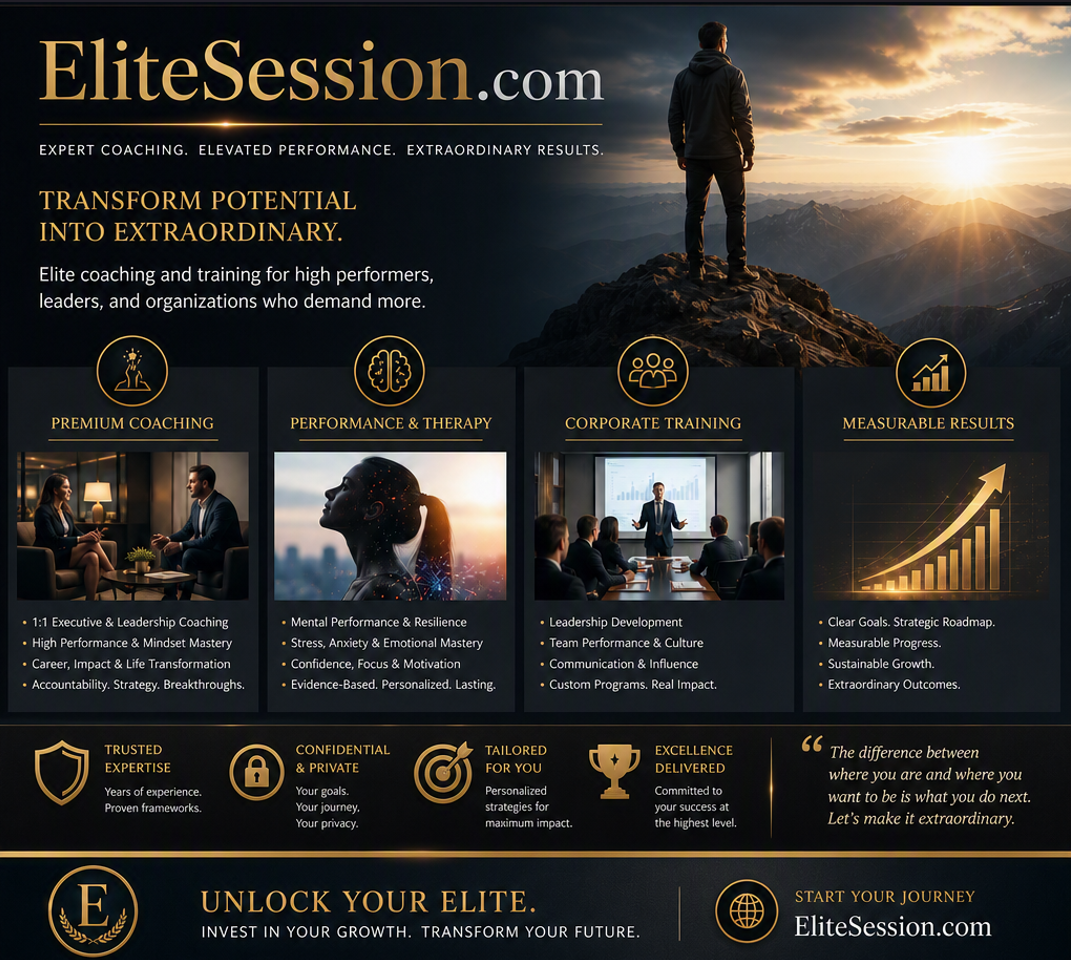
EliteSession.com represents the pinnacle of coaching and performance training — a brand that transforms ordinary sessions into extraordinary experiences. Designed for leaders, therapists, and organizations who demand measurable excellence.
Every interaction becomes a moment of empowerment. Every session, a catalyst for growth. EliteSession.com is not just a domain; it’s a statement of intent — precision, prestige, and purpose aligned.
Position your brand where ambition meets mastery. EliteSession.com is your gateway to a world where expertise commands attention and results redefine success.
Advertibles.com
shortcuts.cam
NoRenewals.com

Feeding starving kids and animals with free clickthroughs? Count on it:
Helping the helpless, especially when you do it quietly, brings YOU more profit.
It is no more and no less than Newton's third Law of Physics in action: "What goes around..."
On buying our domains at discount,
Contact: 1@advertibles.com
If we deem your offer to be fair, we frequently go down another ten percent.
Naturally, we ignore silly offers, and seek to reward those that are upright.
Welcome to the world of premium one-word domains, the only giver of freebies, hm?
Elite sessions, for elite efforts.
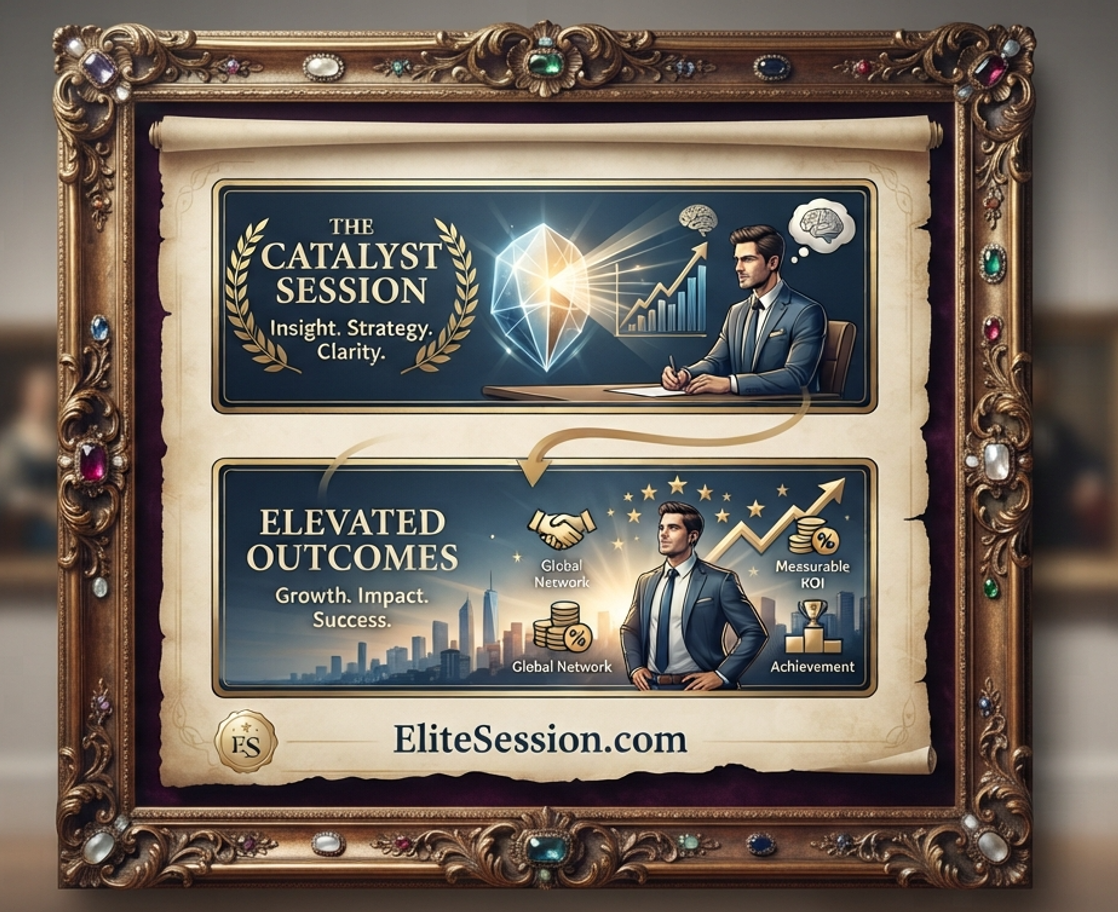
An elite session is never merely a gathering of individuals in a room; rather, it represents a precise intersection where advanced technological infrastructure meets decades of accumulated human expertise. When these two forces combine, the resulting environment transcends traditional educational or corporate formats, creating a transformative space designed to alter perspectives permanently. In this elevated domain, the friction of routine information delivery is eliminated, replaced by a high-bandwidth exchange of deep insights, real-time data modeling, and master-level intuition that resonates long after the session concludes.
At the structural core of any elite session lies the deliberate integration of cutting-edge technology. Modern computational systems, immersive simulation tools, and instantaneous data retrieval mechanisms do not simply act as visual aids; they serve as active cognitive amplifiers. By leveraging state-of-the-art platforms, participants are granted the ability to visualize complex abstract concepts instantly, test hypotheses against rigorous computational models, and interact with dynamic frameworks that would otherwise take months to conceptualize manually. This technological backbone ensures absolute precision, removing latency between thought and execution.
However, technology devoid of human context remains sterile. The true catalyst that transforms raw digital capability into an elite session is the presence of seasoned human experience. Masters of their respective domains bring nuance, intuition, and pattern recognition forged through decades of trial, failure, and ultimate success. While a machine can compute probabilities, a seasoned practitioner understands the unspoken variables, the cultural subtext, and the ethical parameters governing high-stakes decisions. This synthesis allows participants to internalize not just what works, but why it works under specific, volatile conditions.
Designing an environment capable of fostering such high-level synthesis requires meticulous choreography. Every minute of an elite session is architected to manage cognitive load, balancing intense periods of deep analytical immersion with strategic pauses for cognitive integration. The physical or virtual space is optimized to encourage absolute focus, utilizing architectural and ergonomic principles that minimize distraction and maximize psychological safety. In such an atmosphere, participants feel emboldened to challenge foundational assumptions, knowing they are supported by peers and mentors of equal caliber.
The flow of discourse within an elite session departs entirely from standard lecture formats, adopting instead a dynamic, multidirectional peer review model. Facilitators do not merely impart knowledge; they act as master conductors of inquiry, steering rigorous debates that stress-test every premise introduced. Through this crucible of structured critique, ideas are refined, fallacies are exposed, and robust, actionable mental models emerge. Participants learn to articulate complex strategies with absolute clarity, defending their conclusions against rigorous cross-examination from some of the sharpest minds available.
Memory formation during these rare events operates on an entirely different neurological plane compared to routine learning. Because an elite session engages multiple senses, emotional investment, and intellectual stretching simultaneously, the experiences encode deeply into long-term memory structures. Individuals do not just retain facts; they remember the visceral realization of a breakthrough moment, the precise context of a complex problem solved in real-time, and the collaborative synergy that birthed an entirely new way of thinking about their industry or discipline.
Measuring the return on investment of an elite session requires looking far beyond immediate metrics of satisfaction. The true benchmark of success is found in behavioral transformation and paradigm shifts that manifest months and years down the line. Graduates of these sessions consistently report a fundamental upgrading of their internal operational frameworks. They approach challenges with enhanced resilience, systemic clarity, and a sophisticated toolkit that enables them to navigate ambiguity with calm, calculated precision.
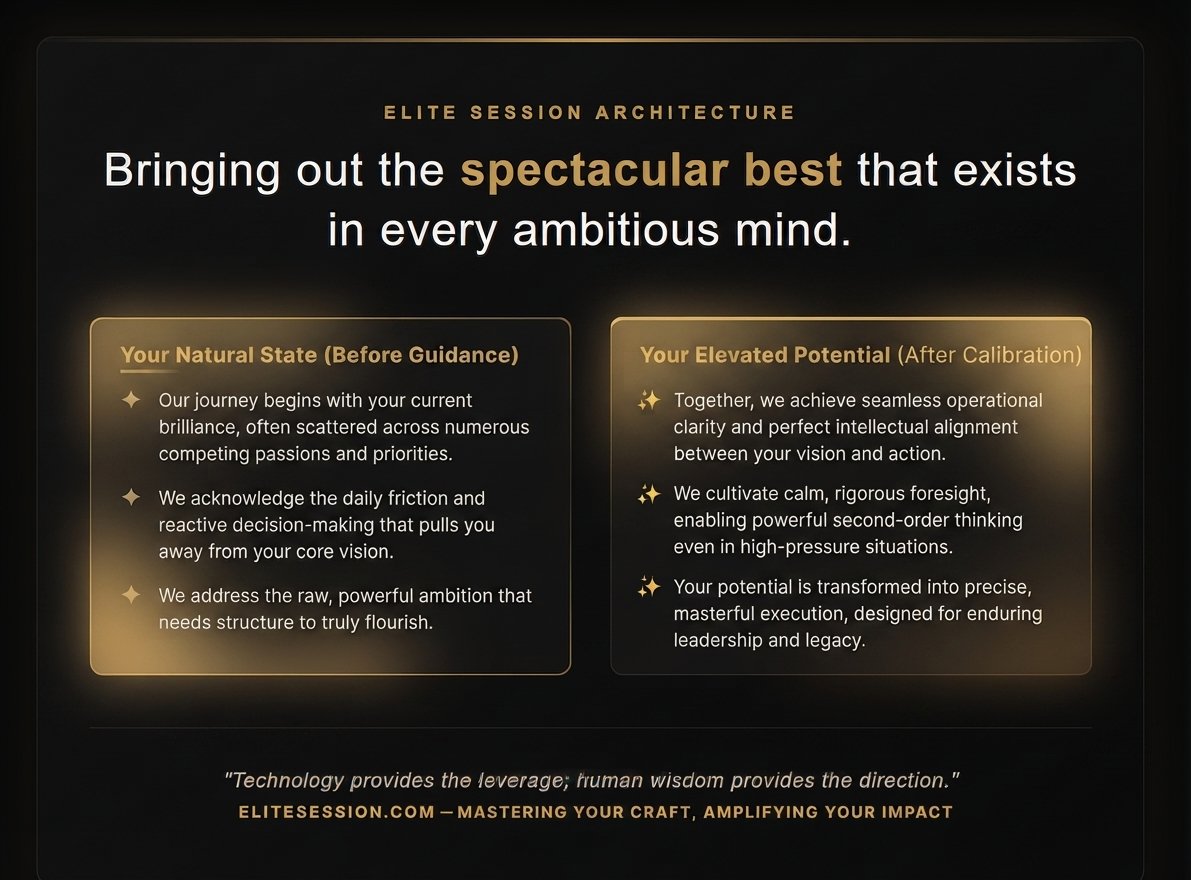
The synergy between human capability and machine intelligence continues to evolve at an exponential rate, elevating the ceiling for what an elite session can achieve. Emerging paradigms in generative analytics, adaptive learning architectures, and high-fidelity sensory immersion mean that future iterations will offer even deeper personalization. Yet, the foundational principle remains unaltered: technology provides the leverage, but human wisdom provides the direction. Balancing these two elements is the ultimate art of transformative session design.
Preparing for such an intensive engagement demands a corresponding level of commitment from the participant. An elite session is not designed for passive consumption; it requires active, unreserved participation, intellectual vulnerability, and a willingness to unlearn outdated mental habits. Those who step into the arena prepared to dismantle their preexisting assumptions invariably extract the highest value, converting the concentrated friction of rigorous debate into lasting intellectual capital.
The legacy of an elite session extends outward, rippling through organizations, markets, and communities. When leaders and innovators undergo a profound recalibration of their capabilities, their decisions become more deliberate, ethical, and forward-looking. The ripple effects of a single well-executed session can realign corporate strategies, accelerate technological breakthroughs, and inspire a renewed standard of excellence across entire professional ecosystems.
Reflecting on the components that define a truly unforgettable session reveals a masterclass in intentionality. Every variable—from the selection of the technological stack to the curation of the attendee roster and the pacing of the curriculum—is optimized for maximum impact. Nothing is left to chance. This meticulous orchestration ensures that participants walk away not merely informed, but fundamentally altered, equipped with a lifetime benchmark for what high-performance collaboration looks like.
Ultimately, an elite session represents the pinnacle of human development methodologies. By fusing the infinite processing power of modern technology with the irreplaceable depth of seasoned human wisdom, these gatherings redefine the boundaries of what is possible. They stand as enduring testaments to the power of structured, high-intensity environments where ambition meets capability, creating memories and proficiencies that endure for a lifetime.
Elite coaching sessions and high-performance intervention models manifest across several key domains of human endeavor. Each arena tailors its protocols to distinct performance metrics, operational pressures, and structural objectives.
Corporate and executive leadership development represents the structural core of modern organizational evolution. Unlike traditional managerial training that focuses on administrative competencies or superficial skills transfer, elite intervention at the C-suite level operates as a rigorous structural reconfiguration. Executives function within environments defined by extreme ambiguity, high-stakes capital allocation, and complex cross-departmental dependencies.
The primary objective of corporate leadership intervention is the systematic dismantling of reactive cognitive habits and their replacement with scalable, analytical frameworks. Decision audits force leaders to deconstruct major past choices, isolating the unstated assumptions and cognitive biases that distorted the outcome. Simultaneously, influence mapping provides a rigorous mechanism for managing stakeholder dynamics, ensuring that strategic intent is translated into precise, persuasive messaging across diverse organizational tiers.
The domain of high-performance athletics and sport psychology operates on the razor-thin margin between physical capability and competitive execution. While physical training, tactical drills, and nutritional programming form the baseline of elite sports, physical conditioning alone is insufficient when athletes face high-stakes, pressure-laden environments. Elite intervention focuses on the optimization of cognitive architectures, emotional regulation, and neuromuscular synchronization.
Athletes operating at the highest tier must execute complex, rapid motor programs under extreme physiological stress and intense public scrutiny. Psychological skills training (PST) protocols introduce systematic stress-inoculation techniques, teaching competitors to consciously regulate autonomic arousal levels. By utilizing controlled breathing, biofeedback, and cognitive reframing, athletes maintain optimal physiological states, avoiding performance-degrading panic.
The arena of high-stakes public speaking and media engagement requires the absolute synchronization of non-verbal communication, rhetorical framing, and tactical composure. Executives, public figures, and institutional leaders frequently face environments where a single misspoken phrase, an inconsistent visual cue, or a defensive reaction can precipitate severe reputational damage. Elite engagement focuses on the underlying cognitive control required to project authentic gravitas under intense scrutiny.
The primary objective is the systematic elimination of defensive reactivity during hostile interactions. Leaders must learn to process aggressive or ambiguous questioning without signaling discomfort or losing control of the core message. Rigorous stress testing, including simulated hostile Q&A sessions designed to elevate autonomic arousal, ensures participants deploy immediate cognitive circuit breakers to restore neutral, commanding delivery.
The domain of elite entrepreneurship and venture scaling demands an uncompromising ability to navigate high-stakes capital allocation, rapid market shifts, and immense organizational turbulence. Founders and scale-up leaders frequently operate under conditions of extreme ambiguity, where traditional management playbooks fail. The primary challenge is not merely ideation, but the structural transformation of a nimble startup into a resilient, scalable enterprise.
Elite intervention for founders focuses on second-order thinking and rigorous risk-reward matrix analysis. Entrepreneurs are trained to look beyond immediate operational hurdles and evaluate the long-term systemic consequences of their capital and resource deployment. This requires developing the capacity to execute rapid, calculated market pivots without destabilizing internal operations or eroding investor confidence.
The domain of tactical, military, and high-risk operations requires absolute precision, split-second decision-making, and unyielding team command stability under life-threatening conditions. In environments where tactical errors result in immediate catastrophic failure, standard corporate management frameworks are entirely inadequate. Operators must execute complex missions under severe sensory overload, acute time compression, and extreme physiological stress.
The primary objective of tactical coaching and high-stress simulation is the systematic inoculation against panic and cognitive tunneling. Elite protocols utilize rigorous stress simulations to elevate autonomic arousal safely, training operators to recognize their individual physical and mental stress triggers. Mastery of after-action reviews (AARs) enforces radical candor, stripping away ego and rank to dissect exactly what happened and how operational procedures must adapt.
As we survey the expansive landscape of elite intervention—from corporate boardrooms and high-performance athletics to public media spotlights, venture scaling, and tactical operations—a singular, unifying truth emerges. Excellence is never an accident of birth or a byproduct of casual circumstance; it is the deliberate, unyielding product of structure, diagnostic rigor, and relentless accountability.
Across every domain of human endeavor, the underlying mechanism of transformation remains identical. Leaders, athletes, founders, and commanders do not achieve enduring dominance by merely working harder within broken frameworks. They achieve it by stepping outside the immediate press of daily operations to deconstruct their own cognitive habits, refine their decision-making architectures, and subject their strategies to uncompromising scrutiny.
In the modern business ecosystem, the velocity of change has outpaced the traditional learning curve. We have entered an era where the "10,000-hour rule" is a luxury no organization can afford. When a leader stumbles, the ripple effects are not measured in quarterly losses alone; they are measured in eroded culture, stalled innovation, and the silent exodus of top talent. Conversely, when a leader undergoes a rapid, profound transformation, the organization doesn't just improve—it accelerates.
This is the promise of high-performance coaching. It is no longer a remedial tool for the struggling executive, nor a vague perk reserved for the C-suite. It is a strategic accelerator, a sophisticated partnership designed to rapidly increase leadership capacity, generating immediate dividends for the individual and sustainable value for the enterprise. To understand this dynamic, we must dissect the anatomy of this transformation and explore how the right engagement turns potential into palpable power.
To understand the value of leadership coaching, one must first distinguish between management and leadership. Management is about controlling complexity; leadership is about catalyzing change. Many executives ascend the corporate ladder because they are excellent managers—masters of process, data, and execution. However, the skills that get you to the top are rarely the skills that keep you there. The higher you climb, the more ambiguous the problems become, and the less your technical expertise matters.
A business coach who specializes in this domain acts as a cognitive architect. They do not teach you how to do your job; they teach you how to think about your job. In a 1 on 1 executive coaching environment, the coach holds a mirror to the leader's mental models. They challenge the assumptions that have become hardened over decades of success. This is the "crucible" moment—the point where a leader realizes that their greatest asset (their experience) can also be their greatest liability if it prevents them from seeing the landscape anew.
Rapid change occurs when an executive shifts from a "knower" mentality to a "learner" mentality. Performance coaching digs into the psychological safety required to admit ignorance. When an executive hire an executive coach, they are essentially paying for the privilege of being told uncomfortable truths in a safe space. The organizational benefit is immediate: a leader who is self-aware is a leader who is less likely to bully, dismiss, or ignore dissent, fostering a culture where innovation can actually take root.
There is a tangible quality to a high-caliber leader that transcends their PowerPoint skills or their financial acumen. It is executive presence. It is the gravitas, the communication clarity, and the emotional agility that allows them to walk into a room and recalibrate the energy. Too often, brilliant leaders are overlooked or undermined not because they lack intelligence, but because they lack presence.
Executive presence coaching is the art of aligning your internal state with your external impact. It is not about becoming a caricature of a tough CEO; it is about authenticity scaled to the audience. A skilled leadership coach identifies the "leakage"—the micro-expressions, the vocal fry, the defensive body language, or the rambling narrative—that dilutes authority. Through deliberate practice and high-fidelity feedback, the executive learns to modulate their communication in real-time.
The utility here is profound. An executive with presence can secure buy-in for a risky strategy in thirty seconds. They can de-escalate a hostile boardroom and articulate a vision that feels inevitable rather than uncertain. For the organization, this reduces "decision friction." When a leader communicates clearly and compellingly, the implementation of strategy is not delayed by interpretation or doubt. The time-to-action shrinks dramatically.
While group seminars and generic training modules have their place, they cannot address the specific, idiosyncratic blind spots of a high-level leader. The machinery of the executive ego is delicate and complex. This is where 1 on 1 executive coaching proves superior. It is a bespoke tailoring, not off-the-rack.
In a private session, the executive coach listens for the narrative beneath the narrative. They identify the recurring patterns in the leader's relationships with direct reports. Is the executive avoiding difficult conversations? Are they micromanaging because they don't trust the process? Are they staying silent in critical meetings out of fear of appearing foolish?
This intimacy allows for rapid course correction. For instance, consider a CFO who is brilliant with numbers but has alienated the rest of the C-suite with an abrasive, hyper-logical communication style. In group training, this CFO would likely dismiss the feedback. In a 1 on 1 executive coaching engagement, the coach can connect the CFO's behavior to their specific professional consequences—burnout among their finance team, slower cross-departmental approvals, and missed revenue targets. By tying the behavior to the leader's own goals, the coach activates intrinsic motivation. The result is a behavioral shift that happens in weeks, not years, because the work is targeted, immediate, and deeply personal.
When we speak of high performance coaching, we are not talking about achieving marginal gains. We are talking about operating in the "flow state" of the business landscape. High-performance leaders are not just productive; they are resilient. They can absorb market shocks without passing the anxiety down the chain of command.
The utility for the organization is best observed through the lens of "leader contagion." Research in organizational psychology demonstrates that a leader's mood and behavior are contagious. If a leader is anxious, cynical, or reactive, that emotion trickles down to the middle managers and infects the front-line employees. Conversely, a leader who exhibits high performance—who remains calm under pressure, decisive in ambiguity, and compassionate in scrutiny—creates a protective buffer for the entire workforce.
Executive coaching services that focus on high performance often utilize biometric and emotional intelligence frameworks. They teach leaders to manage their nervous systems. This is not new-age fluff; it is neurobiology. By learning to interrupt the amygdala's fight-or-flight response during a crisis, the leader allows the prefrontal cortex (the problem-solving part of the brain) to remain in control. The organizational benefit is a culture that does not panic. In volatile markets, a non-panicked culture is a competitive advantage.
Understanding the philosophy is one thing; executing it is another. A robust executive coaching program follows a structured, yet fluid, arc. The most effective programs are time-bound but intensive, usually lasting between six to twelve months, allowing for the crucial "spiral" of learning—where the leader learns something, applies it, fails, learns, and applies it again.
Step 1: The 360-Degree Audit
Before a session even begins, the data must be collected. The executive coach gathers anonymous feedback from the leader's peers, direct reports, and board members. This provides a baseline—a "What is it like to be on the other side of you?" assessment. This is often the most jarring moment for an executive, but it provides the raw material for change.
Step 2: The Contract
The executive and the coach define the outcome. Is it to increase team retention? Is it to secure funding? Is it to successfully merge two warring teams? The goal must be tangible and measurable. This is where performance coaching diverges from therapy; therapy looks backward to heal, while coaching looks forward to build.
Step 3: The Intervention
This is the "lab" phase. The leader enters the 1 on 1 executive coaching sessions with real-world challenges. They practice new communication frameworks. They role-play difficult conversations. They are given micro-actions to try in the workplace—such as leading a meeting without speaking first, or delegating a critical project while maintaining accountability without oversight.
Step 4: Iteration
The executive returns to the next session with data. What worked? What backfired? The coach helps them analyze the outcome without assigning blame. This iterative cycle, repeated over several months, hardwires new neural pathways. The behavior stops being performative and becomes authentic.
For the individual executive, the decision to hire an executive coach is often framed as a vulnerability. They worry it signals weakness. However, in the current market, the opposite is true. To hire an executive coach signals strategic awareness. It says, "I am a valuable asset, and I am investing in my appreciation."
The executive gains an objective confidant. The higher you rise, the harder it is to get honest feedback. Subordinates are scared of you; peers are competitors; the board is judging you. The coach is the only person in the ecosystem with zero agenda regarding your promotion or demotion—their only agenda is your growth. This psychological freedom allows the executive to stress-test ideas that are too raw to share internally, leading to better strategic decisions.
For the organization, the return on investment (ROI) is calculable. Consider the cost of a failed executive hire—which can run into the millions when factoring in severance, lost productivity, and recruitment fees. An executive coaching program costs a fraction of that. Furthermore, a single coaching engagement that results in a 2% increase in team retention or a 5% increase in operational efficiency can pay for itself many times over within the first quarter.
We are moving toward a business environment where "soft skills" are becoming the "hard skills" of the future. As AI commoditizes data analysis and routine tasks, the premium shifts entirely to human-centric capabilities: empathy, persuasion, ethical judgment, and the ability to inspire.
Leadership coaching is the engine for developing these skills at speed. It bridges the gap between technical competence and strategic wisdom. It turns the solitary burden of leadership into a collaborative partnership.
As you evaluate the current landscape of your organization or your personal career, consider the friction points. Where are decisions stalling? Where is turnover highest? Where is innovation lagging? These are not usually market failures; they are leadership failures. And leadership failures are fixable.
The path to rapid leadership change is not found in a book or a weekend seminar. It is found in the uncomfortable, transformative space of a 1 on 1 executive coaching session. It is found in the courage to book a coaching session, knowing that you will be asked the hard questions.
Whether you are looking to refine executive presence coaching to command the boardroom, or seeking high performance coaching to sustain your energy through a grueling merger, the principles remain the same. It requires a willingness to be vulnerable, a commitment to the process, and a belief that the most powerful lever for organizational change is the personal growth of its leader.
The best time to plant a tree was twenty years ago. The second best time is now. The same applies to leadership development. Do not wait for a crisis to reveal the cracks in your leadership foundation. Act now to reinforce them. Hire an executive coach. Engage in leadership coaching. The organization—and the individual within it—will not just survive the future; they will define it.
Executive coaching functions as a systematic intervention designed to optimize leadership behaviors, accelerate professional development, and align individual capabilities with overarching organizational objectives. By utilizing executive coaching services, firms bridge the gap between traditional management training and the high-stakes realities of the C-suite.
The field encompasses various modalities, including leadership coaching, performance coaching, and executive presence coaching. Whether an organization chooses to hire an executive coach or deploy a comprehensive executive coaching program, the impact is measurable and immediate.
At the center of this discipline is the 1 on 1 executive coaching session. These are not merely consultative meetings; they are high-intensity, data-driven laboratories for behavioral change. An effective business coach provides the strategic candor required to dismantle counterproductive habits and replace them with robust operational protocols.
Elite sessions are defined by their rigor. Every interaction requires meticulous preparation, focusing on decision audits, influence mapping, and resilience architecture. Participants who book a coaching session under these protocols gain access to frameworks that sustain peak output under extreme pressure.
Ultimately, high performance coaching is a catalyst for institutional longevity. By refining the cognitive processes of senior leaders, organizations foster a culture of clarity, decisiveness, and accountability that cascades from the boardroom to the front lines, driving superior enterprise performance.